
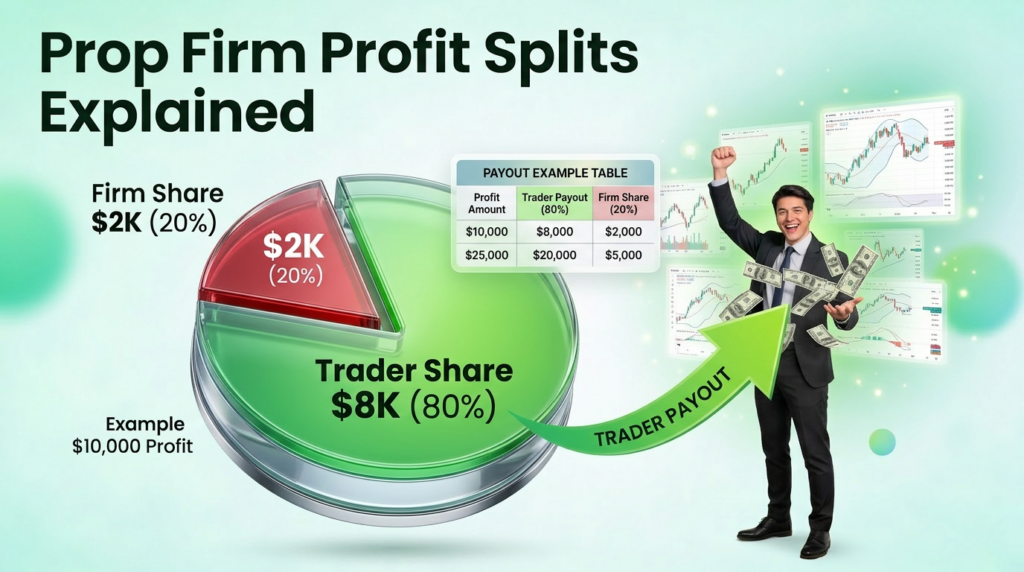
A prop firm profit split refers to the percentage of trading profits that a trader keeps when trading a funded account provided by a proprietary trading firm.
When traders use their own capital, they keep 100% of the profits. However, when trading with a prop firm’s funded account, profits are shared between the trader and the firm.
The trader receives a percentage of the profits, while the firm keeps the remaining portion. This percentage is called the profit split.
For example, if a prop firm offers an 80% profit split, the trader keeps 80% of the profits, and the firm keeps 20%.
Profit splits determine how much money a trader receives when they generate profits on a funded account.
Here is a simple example:
Account size: $100,000
Monthly profit: $10,000
Profit split: 80%
| Total Profit | Trader Receives | Prop Firm Receives |
|---|---|---|
| $10,000 | $8,000 | $2,000 |
The trader receives $8,000, while the prop firm keeps $2,000.
This structure allows traders to access large trading capital without risking their own funds.
Most proprietary trading firms offer profit splits ranging between 70% and 90%.
Here are the most common structures:
| Profit Split | Trader Share | Firm Share |
|---|---|---|
| 70% | Trader keeps 70% | Firm keeps 30% |
| 80% | Trader keeps 80% | Firm keeps 20% |
| 90% | Trader keeps 90% | Firm keeps 10% |
Many firms start traders at 80%, then increase the split once traders prove consistency.
Some prop firms even offer up to 95% profit splits for experienced traders or scaled accounts.
Profit splits are how proprietary trading firms generate revenue while providing traders with capital.
Instead of charging ongoing fees, the firm earns a portion of the profits traders generate.
This system benefits both sides:
Access to large trading capital
Limited personal financial risk
Ability to scale accounts over time
Earn a share of successful traders’ profits
Incentivize disciplined trading
Build a network of profitable traders
One of the biggest differences between prop trading and personal trading is the profit distribution.
Trader keeps 100% of profits
Trader takes 100% of the risk
Trader keeps 70–90% of profits
Trader risks little or none of their own capital
For many traders, keeping 80% of profits from a $100,000 account can be more attractive than keeping 100% of profits from a $5,000 personal account.
Some prop firms offer profit split upgrades as traders demonstrate consistent performance.
For example:
| Stage | Profit Split |
|---|---|
| Starting account | 80% |
| After consistent profits | 85% |
| After scaling | 90% |
These increases reward traders who maintain strong risk management and steady performance.
Higher profit splits allow traders to earn more from the same trading results.
Profit splits only matter when profits are actually paid out.
Most prop firms have payout schedules that determine when traders can withdraw their profits.
Common payout schedules include:
Bi-weekly payouts
Monthly payouts
On-demand payouts
Before choosing a prop firm, traders should check:
Minimum payout thresholds
Withdrawal processing time
Payment methods available
Let’s compare earnings from different profit splits.
Assume a trader makes $5,000 in profit on a funded account.
| Profit Split | Trader Earnings |
|---|---|
| 70% | $3,500 |
| 80% | $4,000 |
| 90% | $4,500 |
Even a 10% increase in profit split can significantly increase long-term trading income.
When reviewing prop firms, traders should consider more than just the headline percentage.
Important factors include:
Some firms begin at 70%, while others start traders at 80% or higher.
Higher starting splits allow traders to keep more profits from the beginning.
Some firms cap profit splits at 90%, while others allow traders to reach 95% through scaling programs.
Higher maximum splits improve long-term profitability.
Many prop firms combine profit split increases with account scaling plans.
As the account grows, the trader may receive both:
Larger account size
Higher profit percentage
Not necessarily.
Some firms advertise extremely high profit splits but have strict trading rules, lower drawdown limits, or difficult payout conditions.
When comparing prop firms, traders should also evaluate:
Maximum drawdown rules
Daily loss limits
Challenge difficulty
Payout reliability
A slightly lower profit split from a reliable firm with fair rules may be more valuable in the long run.
Profit splits are one of the most important factors when choosing a proprietary trading firm.
They determine how much of your trading profits you keep when using a funded account.
Most prop firms offer profit splits between 70% and 90%, with higher percentages often available through scaling programs or consistent performance.
Before joining a prop firm, traders should always compare:
Starting profit split
Maximum split available
Payout schedule
Trading rules
Understanding profit splits helps traders choose firms that offer the best balance between capital access and profit potential.
Honestly, transparently, and with real results. Our prop firm reviews are here to help you make the most informed choice when selecting your next funded trader program.
With years of trading experience and deep market knowledge, our team stays on top of industry trends, policy updates, and new proprietary trading firms entering the scene. We understand the importance of selecting a reliable prop firm that offers competitive profit splits, scalable accounts, and flexible trading rules. Whether you’re a beginner looking for your first funded account or a professional seeking the best prop firm for your strategy, we’re here to guide you every step of the way.
Start Your Trading Journey with the Best Prop Firms Today!
At PropFirm-Reviews.com, we offer comprehensive insights and recommendations on the best prop firms to help you take your trading to the next level. No matter your experience, our reviews and offers will ensure you find the right prop firm that aligns with your goals. Start trading smarter with the best prop firms today!
Copyright © 2026 propfirm-reviews.com