
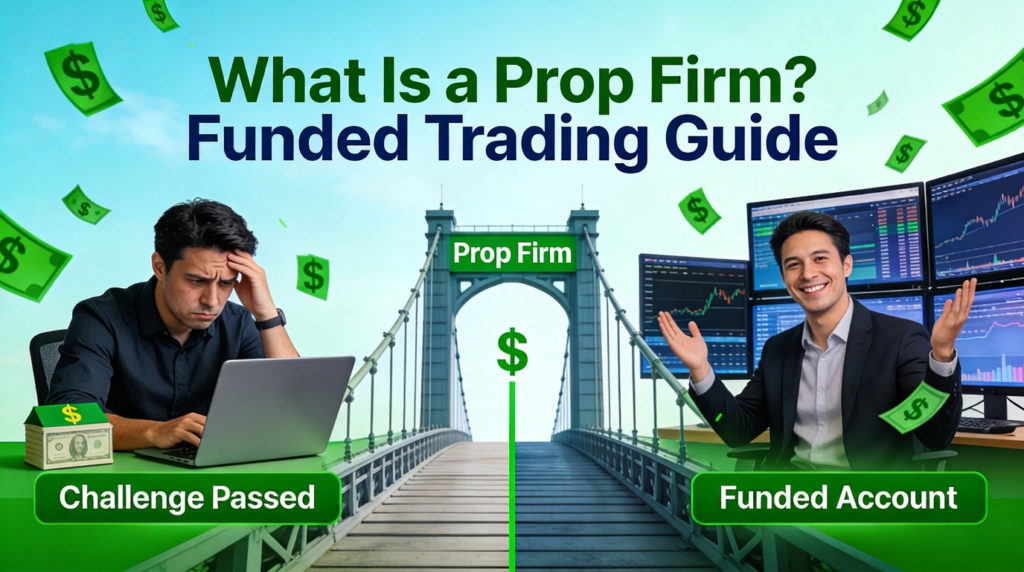
If you’re a trader looking to grow your trading account without risking your own money, you’ve probably heard of prop firms. But what exactly is a prop firm, and how can it help you trade professionally? In this guide, we’ll break down everything you need to know about proprietary trading firms, including how they work, the different types, and tips to get funded.
A prop firm (short for proprietary trading firm) is a company that provides traders with capital to trade financial markets, such as forex, stocks, futures, or crypto. Instead of using your own money, you trade the firm’s funds and share a percentage of the profits you generate.
Trading with a prop firm allows you to scale your account faster, access professional tools, and learn risk management strategies used by top traders—all without risking your personal savings.
Most prop firms operate using a few key principles:
Before receiving a funded account, traders usually need to pass a challenge or evaluation. This tests your trading skills, risk management, and consistency. Passing this stage proves that you can trade responsibly with the firm’s capital.
Once funded, traders keep a percentage of the profits they generate—usually 70-90%, while the firm takes the remainder. This incentivizes traders to perform well while protecting the firm’s capital.
Prop firms implement strict risk rules to safeguard their funds. These may include:
Maximum daily loss limits
Maximum overall drawdowns
Trade size restrictions
Unlike traditional trading, your personal money is not at risk. However, many prop firms charge a one-time or recurring fee for the evaluation or membership.
Prop firms generally fall into two categories:
Often require traders to work on-site.
May provide a salary plus profit share.
Usually focus on professional or experienced traders.
Allow traders to work from anywhere.
Typically require passing a funded trading challenge.
Popular examples include FTMO, The5ers, and Apex Trader Funding.
Access to professional capital without risking personal savings
Faster growth potential with larger accounts
Structured risk management teaches disciplined trading
Opportunity to trade multiple markets without significant financial risk
Start with small goals – Focus on consistency rather than high profits.
Learn risk management – Stick to maximum loss limits and position sizing rules.
Practice on demo accounts – Many firms allow you to simulate the challenge before committing.
Research prop firm reviews – Choose a firm with fair rules, transparent profit splits, and reliable payouts.
Check out our top prop firm reviews to see which funded trading program matches your style and goals. Start trading with professional capital and take your trading to the next level!
Honestly, transparently, and with real results. Our prop firm reviews are here to help you make the most informed choice when selecting your next funded trader program.
With years of trading experience and deep market knowledge, our team stays on top of industry trends, policy updates, and new proprietary trading firms entering the scene. We understand the importance of selecting a reliable prop firm that offers competitive profit splits, scalable accounts, and flexible trading rules. Whether you’re a beginner looking for your first funded account or a professional seeking the best prop firm for your strategy, we’re here to guide you every step of the way.
Start Your Trading Journey with the Best Prop Firms Today!
At PropFirm-Reviews.com, we offer comprehensive insights and recommendations on the best prop firms to help you take your trading to the next level. No matter your experience, our reviews and offers will ensure you find the right prop firm that aligns with your goals. Start trading smarter with the best prop firms today!
Copyright © 2026 propfirm-reviews.com