
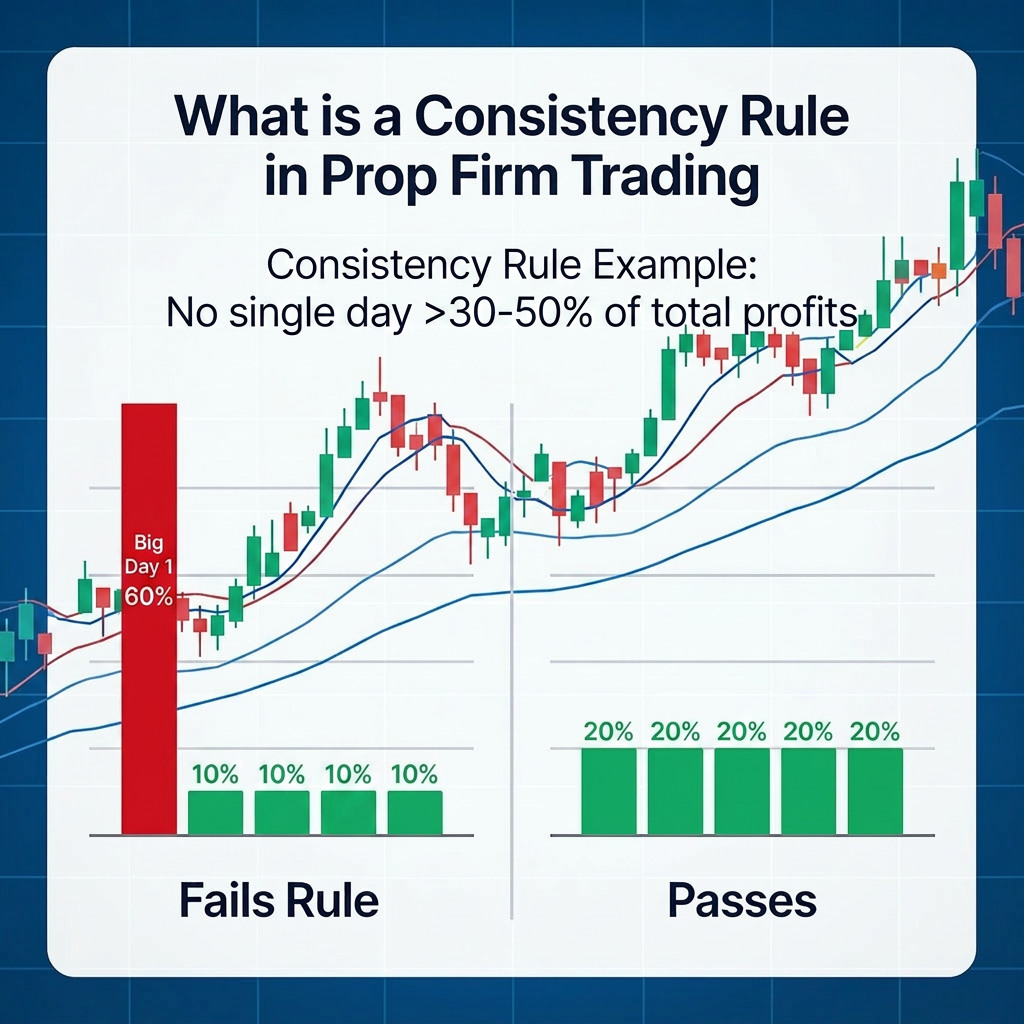
A consistency rule is a requirement used by many proprietary trading firms (prop firms) to ensure traders generate profits in a stable and consistent way, rather than relying on a single large winning trade.
When traders participate in a prop firm challenge or evaluation, they must usually meet certain conditions such as profit targets and maximum drawdown limits. Some firms also include a trading consistency rule that prevents traders from passing the evaluation through one lucky trade.
Instead, profits must be distributed across multiple trades or trading days, demonstrating disciplined trading and proper risk management.
Prop firms provide traders with access to large amounts of capital, sometimes ranging from $10,000 to $200,000 or more. Because the firm carries the financial risk, they want traders who can show reliable performance over time.
A consistency rule helps prop firms:
Identify traders with sustainable trading strategies
Prevent high-risk “all-in” trading
Encourage proper risk management
Ensure profits are repeatable rather than luck-based
Without a consistency rule, a trader might pass a challenge by placing one extremely risky trade that happens to win.
The exact structure of a prop firm consistency rule varies between firms, but the most common version limits how much profit can come from a single trading day.
For example, a firm might say:
“No single trading day can account for more than 30% of total profits.”
Imagine a trader completes a prop firm challenge with $5,000 in total profit.
If the rule states that no single day can exceed 30% of total profits, the maximum profit allowed from one day would be:
$1,500
If the trader made $3,000 in one day, the account would violate the consistency rule, even though the profit target was reached.
Different prop firms enforce consistency in slightly different ways.
This rule limits how much of the total profit can come from one trading day.
Example:
Maximum daily profit = 30–40% of total profits
This ensures profits are spread across several trading sessions.
Some prop firms require traders to trade for a minimum number of days before completing an evaluation.
Example:
Minimum 5 trading days
At least 3 profitable trading days
This rule ensures traders are not simply passing a challenge in one day.
Some firms monitor position sizes to ensure traders maintain consistent risk per trade.
Example rules may include:
Maximum position size limits
No trade larger than 2–3× the trader’s average size
This helps prevent gambling behavior.
| Day | Profit |
|---|---|
| Day 1 | $700 |
| Day 2 | $650 |
| Day 3 | $900 |
| Day 4 | $600 |
| Day 5 | $800 |
This example shows steady profit generation, which is what prop firms prefer.
| Day | Profit |
|---|---|
| Day 1 | $4,500 |
| Day 2 | $50 |
| Day 3 | $30 |
| Day 4 | -$20 |
Here, almost all profit comes from one trading day, which may violate the consistency rule.
No. Some proprietary trading firms do not enforce a consistency rule, while others apply it only at certain stages, such as:
During the prop firm challenge
During funded account withdrawals
When verifying risk management behavior
However, many modern prop firms are adopting consistency rules to identify disciplined traders.
Traders can improve their chances of passing a prop firm evaluation by following these practices:
Avoid risking too much on a single position.
Aim for steady daily gains rather than a large one-day win.
Keep lot sizes similar across trades.
One oversized trade can easily break consistency requirements.
The consistency rule in prop firms is designed to promote disciplined and sustainable trading behavior. While it may make evaluations slightly more challenging, it helps ensure traders develop habits necessary for long-term success.
Traders who focus on steady profits, controlled risk, and consistent strategies will find it much easier to meet these requirements.
Honestly, transparently, and with real results. Our prop firm reviews are here to help you make the most informed choice when selecting your next funded trader program.
With years of trading experience and deep market knowledge, our team stays on top of industry trends, policy updates, and new proprietary trading firms entering the scene. We understand the importance of selecting a reliable prop firm that offers competitive profit splits, scalable accounts, and flexible trading rules. Whether you’re a beginner looking for your first funded account or a professional seeking the best prop firm for your strategy, we’re here to guide you every step of the way.
Start Your Trading Journey with the Best Prop Firms Today!
At PropFirm-Reviews.com, we offer comprehensive insights and recommendations on the best prop firms to help you take your trading to the next level. No matter your experience, our reviews and offers will ensure you find the right prop firm that aligns with your goals. Start trading smarter with the best prop firms today!
Copyright © 2026 propfirm-reviews.com